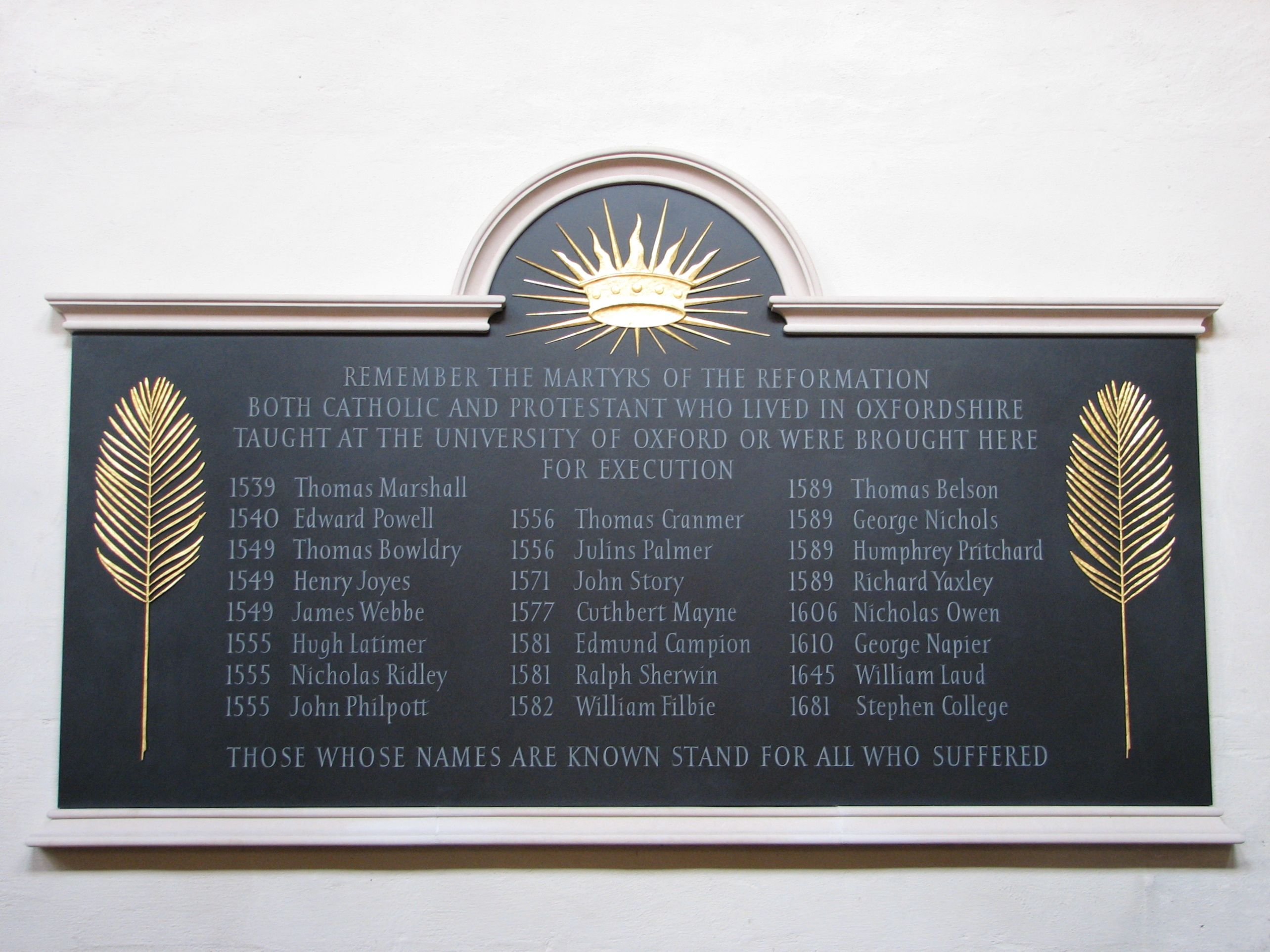
The memorial commemorates the Catholic and Protestant Oxfordshire men put to death for their beliefs in the Reformation period: 16 of the former and 7 of the latter. It was inspired by a similar one in the chapel of Eton College. My wife and I heard about it when we were present at a service on in the chapel at Stonor Park (Henley), at which Cormac Murphy-O’Connor, Archbishop (later Cardinal) of Westminster, was the preacher. He began his sermon by saying that he had recently dedicated (on 5 May 2003), with the Anglican bishop Simon Barrington-Ward, a memorial to the former pupils of Eton who died for their beliefs in the Reformation years. Their names (with the date of death) are carved in stone in alphabetical order without mention of affiliation. As I, an Anglican married to a Catholic, listened to the archbishop, I said to myself, “We need one of these in Oxford”.
I started by putting the idea to Professor (now Sir Diarmaid) MacCulloch, FBA, then professor of the History of the Church in the University of Oxford and Fellow of St Cross. He warmly endorsed it. We agreed that the perfect place for the Oxford memorial was the University Church of St Mary the Virgin. The parish council of St Mary’s welcomed the idea. Professor MacCulloch and his colleagues began work to identify the people who should be named on the memorial. We sent the list to the Revd Professor John Morrill, FBA, then professor of British and Irish History in the University of Cambridge and honorary fellow of Trinity College, Oxford, who is now a Roman Catholic priest. We wanted him to be the co-sponsor, with Professor McCulloch, of the project. Professor Morrill fully supported it. He wrote that it was “timely because relations between members of the various Christian communities are at long last warm and generous, at least in England and Wales; and because the imputation of sedition to those who do not share our faith is still too much of a reality”.
Martin Jennings FRSS, who at that time was turning from letter-cutting to sculpture (for which he is now renowned), was commissioned to design and make the memorial.
Following the example of Eton College, the memorial simply lists 23 men, ordered by year of death. All were people of Oxfordshire, or the University, or were brought to Oxford for execution. It is in a prominent position on the north side of the nave in St Mary’s. The names are inscribed on slate framed by Portland stone with a crown and palm-fronds cast in bronze.
In Professor MacCulloch’s words, the intention of the monument is ‘to reconcile rather than emphasise and celebrate separation. It is designed to create common memory: to provoke contemplation on the sincerity of faith held by both sides, rueful reflection on the sincerity of faith which led Christians to bring Christians to often prolonged and ghastly deaths, and meditation on the future of a religion which has begun to realise how necessary it is to follow the command of Jesus that all who believe in him may be one’.
The cost was about £20,000 and it was met by grant-making trusts, the University Church itself, Campion Hall, Oxford, members of the family of Bishop Nicholas Ridley and many individuals, among them Lord Patten of Barnes, then Chancellor of the University of Oxford. Both the Chancellor and the Registrar of the diocese of Oxford, without whom we would not have the legal authority to realise the project, waived their fees.
Bringing about the memorial took time and was not straightforward. Although the then vicar, Canon Brian Mountford OBE, was warmly supportive from the start and obtained a significant donation, the proposal attracted some objections from both Catholics and Protestants. The chairman of the Latin Mass Society wrote to criticise the whole idea and the Chancellor of the diocese of Oxford at first declined to grant a faculty: as an ecclesiastical lawyer he had reservations about honouring in a church a man who had been convicted of high treason. But Professor MacCulloch persuaded him to change his mind on the basis of precedents. By that time, we were quite close to the date we had fixed for the service of dedication, so not everyone we had hoped to be present was able to be.
The service was held on 19 June 2008. Professor MacCulloch and Lord Patten gave addresses and the sub-dean of Christ Church, the Revd Nicholas Coulton, the Most Revd Timothy Radcliffe OP, master of the Dominican order from 1992 to 2001 (now a cardinal) and the Revd David Cooper, minister of Wesley Memorial Methodist Church, offered prayers.
In his address Professor MacCulloch pointed out that the Martyrs’ Memorial in St Giles was “raised as a conscious gesture of Anglican self-assertion”. I remembered feeling that there was an element of that spirit during the run-up to the canonization of the forty Catholic martyrs of England and Wales in 1960. It was thoughts like these, and the experience of the Catholic Church which my wife brought me, that led me to advance the project. But it would never have come about without the encouragement and hard work of Diarmaid MacCulloch and Brian Mountford.
People tell me that the memorial is appreciated by visitors to the church, deeply by some.
I helped him bring about a memorial tablet, at the east end of Holywell Street, for three Catholics commemorated in the University Church and a plaque to one of those three at Oxford Castle.
(An account given to us by Hugo Brunner)