Modern St Mary’s (1900-present)
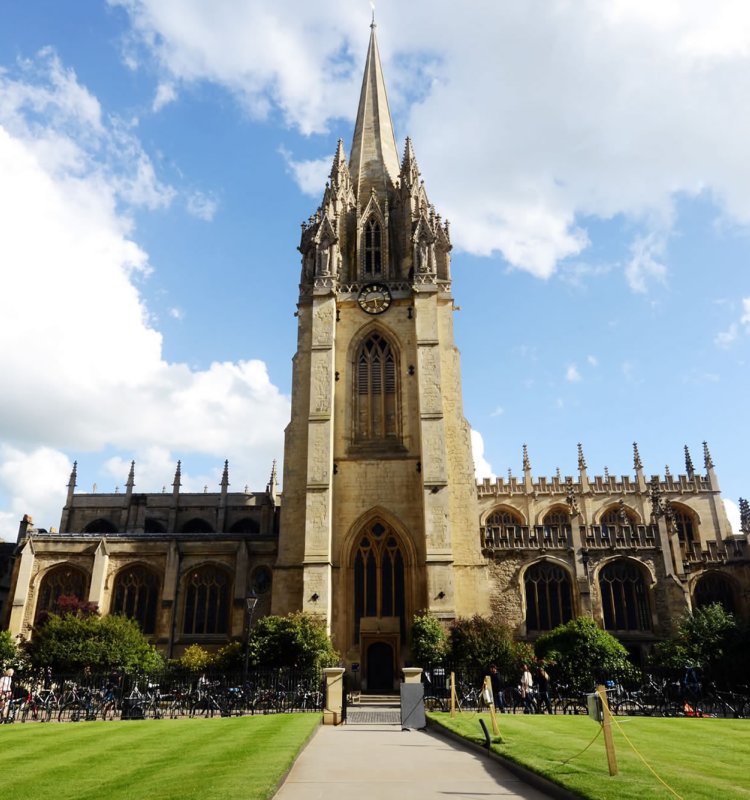
St Mary’s has played a leading role in the life of the Church of England; but over the last hundred years it has also worked for the wider community. In the period leading up to the Second World War, the life of this Church was shaped particularly by what became known as ‘the social gospel’. This was a movement committed to applying the teaching of Jesus to social and economic issues in the world, and to alleviating poverty and injustice within society. In England, the chief figure was Archbishop William Temple, who insisted that Christians should live out their faith not only in their personal lives but through their efforts to reform society as a whole. In 1931 he led a mission in St Mary’s which was said to have inspired a whole generation of undergraduates to become priests in the Church of England. These young men believed that they could really make a difference in the world through their work as clergymen.
In 1939, the Vicar of St Mary’s, Canon Dick Milford, welcomed a group of German Jewish converts to Christianity who had fled from Nazi persecution, inviting them to worship in this church. This was a gesture of friendship and of practical Christianity at a key moment in time, for the Second World War would break out later that year and Britain and Germany would go to war against each other. The congregation was led by a brave and scholarly Lutheran pastor, Hans-Werner Kramm, and among its members was Sabine Leibholz-Bonhoeffer, twin sister of Dietrich Bonhoeffer. The German Lutheran congregation still meets here once a month for worship, drawing a congregation from the many German speakers living in and around Oxford.
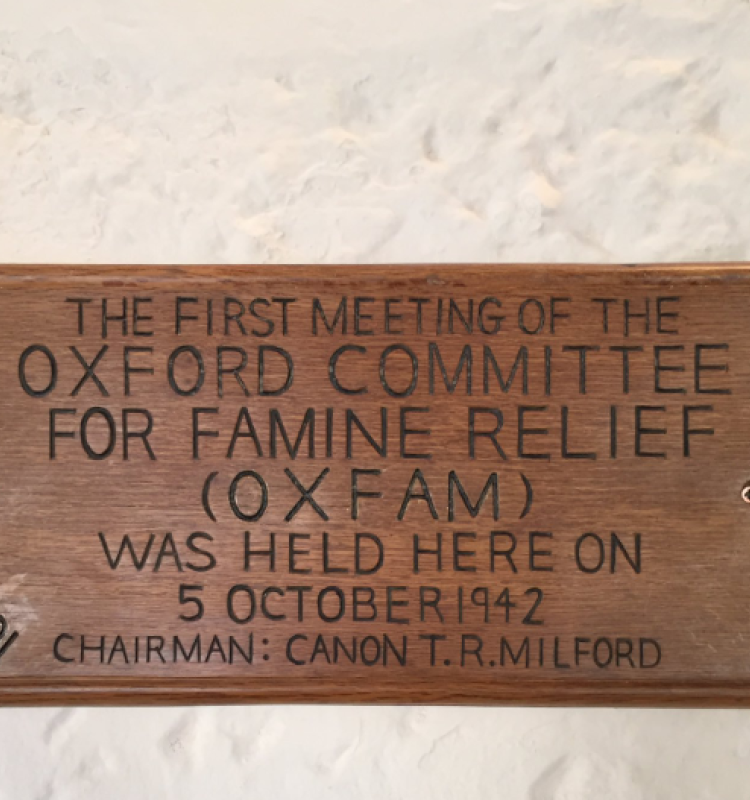
The Second World War caused terrible suffering, and the people of Oxford and St Mary’s were anxious to do more to help the people affected by the fighting. They were particularly troubled by the Nazi occupation of Greece and the consequent Allied naval blockade, which led to acute famine for the Greek people. Early in the 1940s, fund-raising Committees for famine relief were set up in London and several other British cities, and in 1942 an Oxford Committee for Famine Relief met in the Old Library of the University Church. It was chaired by the Vicar, Dick Milford. This was the first meeting of what would later become OXFAM, the major international relief agency we know today.
In the latter part of the century, Britain saw a massive drop in the numbers of people attending church as secularisation took hold and people began to question the religious assumptions of the past. St Mary’s managed to buck this trend with the help of a succession of lively, academic associate priests, who ran a series of exploratory courses under the general title, ‘In search of God’. They found that students, parishioners and visitors were drawn to these courses, in which they could examine their own ideas and beliefs and come to their own conclusions about the traditions and values of Christianity. In recent years, the Church has also begun an education programme aimed at school children and visitors, thanks to a major grant from the Heritage Lottery Fund. Many people from the congregation and beyond act as welcomers and guides, serving the thousands of visitors who enjoy this historic and inspiring church every year. And the Church has embraced new technologies, like the web, as part of its ongoing mission to help people understand the faith and the history of this place.